
Your Core Is not Just Your Abs
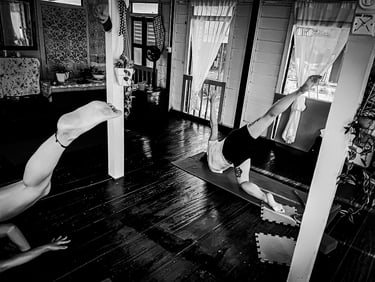
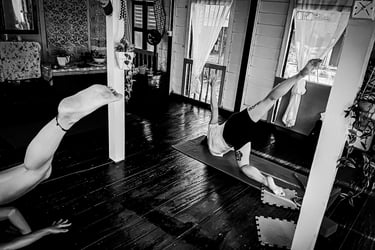
A pose like Thread the Needle with the leg lifted challenges this system directly. The cross-body rotation requires asymmetric pressurisation to prevent the spine from collapsing or over-rotating. When breath is integrated, you are training the stabilising cylinder in real time. The lifted leg further increases the demand, compelling the “floor” and “walls” to counter gravity’s pull.
This stabilising pressure is not brute strength. It is a coordinated blend of muscular engagement and breath. By maintaining a steady breathing rhythm, the cylinder remains pressurised yet responsive. Each inhale and exhale moves the diaphragm through its role as the “roof,” training the system to stabilise dynamically rather than rigidly.
The sequence, with its variations in arm support, progressively mobilises the upper torso. It evolves from a gentle spinal rotation that opens the shoulders and chest into a balancing pose that strengthens the spine and hips. In doing so, it trains your core cylinder to be both adaptable and strong.
Your core is not just your “abs,” but a pressurised cylinder with four integrated parts:
The roof: the diaphragm, your primary breathing muscle.
The floor: the pelvic floor, a sling of muscles at the base of the pelvis.
The walls: the deep abdominal muscles wrapping around the torso.
The back support: the muscles running along the spine.
These four components work together to create internal pressure, forming a dynamic brace that stabilises the spine during everyday actions, such as standing up from a chair or preparing to walk.
Endnote
If you are planning a pregnancy, this work becomes especially significant. By cultivating a resilient internal “container,” incorporating this practice can:
Support postural changes as your centre of gravity shifts.
Provide a stable foundation for the pelvis and spine under increasing load.
Establish a breath–movement relationship that becomes invaluable during labour and recovery.
More Insights