
Supination : The Great Unwinding
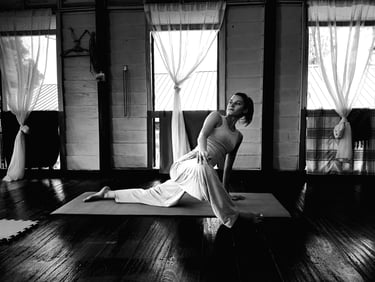
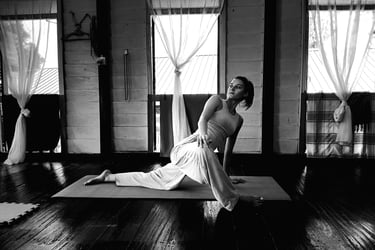
The Lizard Lunge Test: Why Asymmetry Reveals Everything
In asymmetrical postures like Lizard Lunge, the body can’t hide its adaptations.
The front foot becomes the anchor. For someone with habitual supination, that foot instinctively rolls towards its outer edge. When this happens, the knee drifts outward and the hip joint loses space. To stay in the pose, the spine steps in to compensate - rounding through the upper back or compressing the neck to reach the floor.
When the base of the big toe is consciously grounded and the inner arch engages, the shin subtly reorganises. This small shift creates space in the hip socket, allowing the pelvis to level. Once the pelvis stabilises, the spine no longer needs to distort itself to maintain balance.
It sounds almost too simple, but that’s how integrated systems work.
A Note on the Psoas
The psoas connects the inner thigh to the lumbar spine and plays a key role in load transfer between the legs and the torso. In a chronically supinated pattern, the leg remains externally biased, keeping the psoas in a shortened, twisted state. This contributes to a persistent anterior pull on the lumbar spine and an exaggerated arch.
When the leg aligns - often beginning with something as basic as grounding the big toe - the psoas can lengthen more efficiently. Because of its direct relationship with the vertebrae, this change reduces unnecessary tension through the lower back. The spine isn’t being “fixed”; the forces pulling it out of alignment are simply no longer there.
Chronic misalignment - such as a supinated foot leading to an externally rotated leg and a persistently tilted pelvis - is not a flaw. It’s an adapted strategy. The nervous system accepts this pattern as “normal” because it keeps you upright and functional, even if it’s inefficient and eventually painful.
When you address the foundation - the feet and legs - you’re not simply repositioning bones. You’re removing the requirement for the spine to distort itself in order to maintain balance. Once the base becomes stable and predictable, the nervous system no longer needs to brace the spinal muscles defensively. The spine doesn’t need to be corrected; it finally feels safe enough to return to its natural curves.
The brain’s primary postural goal is simple: keep the eyes level with the horizon. If the feet and hips are misaligned, the spine must twist, arch, or compress to achieve this. When the legs organise more neutrally, the nervous system recognises that these compensations are no longer necessary - and it lets them go.
Why the Body Unwinds in Spirals
Human movement isn’t linear. We don’t hinge or rotate in isolation; we organise ourselves through spirals. A locked, supinated foot disrupts this natural sequencing. When the foot begins to “un-spiral” - regaining the ability to evert, spread, and adapt - that change travels up the leg, through the pelvis, and allows the spine to unwind upward towards the crown of the head.
This isn’t a technique imposed from above. It’s a release of a pattern that no longer serves.
Layered Integration: Why Order Matters
In physical therapy and advanced movement coaching, this approach is often described as layered integration. You can’t finish the feet before working on the hips, because the hips don’t receive clear information until the feet provide better data.
Each phase serves a distinct role:
Phase 1 - Mobilise: You give the nervous system permission to explore a new range. With long-standing supination, this phase demands patience and attention
Phase 2 - Realign: You show the nervous system where that new range should organise - for example, grounding the big toe in Tadasana.
Phase 3 - Stabilise: You reinforce the change by strengthening the muscles, such as the glutes and deep core, that prevent the system from collapsing back into old habits.
Together, these phases create a conversation within the body rather than a correction imposed upon it.
From Managing Pain to Resolving Patterns
Chronic pain often feels like something that happens to you. But when you understand the chain - foot to leg, pelvis to spine, ground to crown - you regain agency. You’re no longer waiting for your back to improve on its own. You’re actively unwinding the pattern that created the problem in the first place.
That’s the difference between managing symptoms and resolving causes.
Endnote:
If you’ve been rolling onto the outer edges of your feet for years - or decades - Phase 1 isn’t a warm-up. It’s the heart of the work.
The nervous system may have lost its ability to sense the inner arch, evert the ankle, and recruit the peroneals. Without restoring this awareness first, attempts to realign or stabilise will simply reinforce the very compensations you’re trying to change.
More Insights