
Supination - The Locked Foot
A 3-Step Realignment Protocol
We use the Pawanmukhtasana Series 1 (the "Joint Loosening" series) to unlock the lower kinetic chain and retrain the body's posture.
Phase 1 : Mobilize the Foundation
These movements "wake up" the muscles on the outside of the shin (the peroneals) that have gone dormant.
Toe Spreading (Padanguli Naman): Restores the wide base needed for balance.
Ankle Rotations (Goolf Chakra): Lubricates the subtalar joint to break the "locked" pattern.
Calf & Achilles Stretch (Janu Naman): Releases the tension that pulls the foot into a high arch.
Phase 2 : Realign & Balance
Now that the joints are mobile, we teach the body a new "neutral."
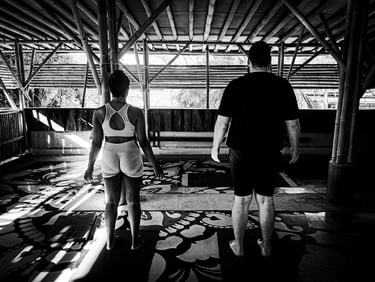
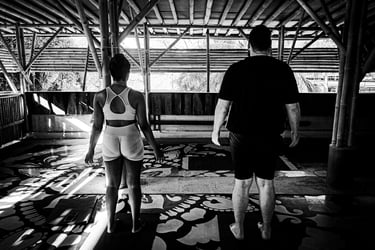
Mountain Pose (Tadasana): Focus on grounding the base of the big toe.
Tree Pose (Vrksasana): Challenges your stabilizers to maintain a level pelvis while the foot stays flat.
Gate Pose (Parighasana): Stretches the lateral (side) body structures that get tight from a supinated gait.
Foot Supination - the tendency to roll your weight onto the outer edges of your feet - creates a "domino effect" that travels from your ankles all the way to your neck.
The Problem: The "Locked" Foot
When you supinate, your foot becomes a rigid lever rather than a shock absorber.
The Arch: High and "locked," refusing to flatten and rebound.
The Rotation: The ankle turns the sole inward, forcing the shin and thigh bones to rotate externally (outward).
The Pelvic Tilt: To keep you from falling over, your body compensates by tilting the pelvis forward, often causing the tailbone to "tuck up" or stick out.
This misalignment leaves your lower back in a state of constant mechanical stress, leading to what many call "non-specific low back pain."
Phase 3 : Stabilize the Core & Decompress
Once the legs are aligned, we must "lock in" the progress by strengthening the center.
Bridge Pose (Setu Bandhasana): Wakes up the glutes to pull the pelvis back into a neutral position.
Boat Pose (Paripurna Navasana): Engages the deep core to support the lumbar spine.
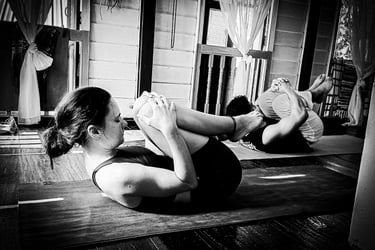
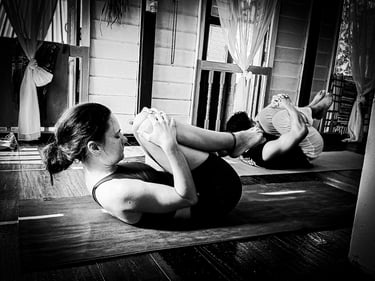
Knees-to-Chest (Apanasana) & Cat-Cow: Gently "massages" the vertebrae, creating space where there was once compression.
Your feet are your foundation. By focusing on how you distribute weight through your soles, you aren't just fixing a "foot problem" - you are giving your spine the freedom to move without pain.
More Insights